The Pepper Mild Mottled Virus (PMMoV) is an RNA virus and one of the most destructive pathogens affecting chili crops. Due to its high infectivity and stable persistence in soil, this virus has garnered increasing attention as a potential viral indicator of human fecal contamination in aquatic environments and water treatment
systems. Recent studies have demonstrated a statistically significant correlation between the detection rate of PMMoV in feces and host-specific immune responses, suggesting its potential pathogenic risk to human health. Given PMMoV's remarkable environmental stability in contaminated seeds, plant residues, dry soils, and water bodies, it poses significant threats to ecological security and food safety.
The potential threats to food safety and public health are receiving increasingly widespread attention. The chili pepper light mottling virus (PMMoV) test strip developed by our company offers several advantages: it requires no specialized technical personnel, is simple, rapid, accurate, non-contaminating, does not rely on expensive detection instruments, and can be visually assessed without laboratory equipment.
Instructions for Chili Small Mottled Virus (PMMoV) Test Strip
I. Kit Composition:
PMMoV test strips, 50 strips
Plant tissue grinding bags, 50 pieces
50 mL sample extraction solution per bottle
II. Operating Steps:
1. Sample preparation:
1.1 Method 1 for Plant Sample Preparation:
1) Collection of plant samples: Take a piece of leaf tissue the size of a thumb nail (30–50 mg) from chili leaves exhibiting pronounced virus-like symptoms such as chlorosis and wilting, using hands or scissors; or collect half a piece of fruit the size of a thumb nail (30–50 mg) from fruits showing deformities like twisting or wrinkling, or brown necrotic lesions and streaks, using hands or scissors. Place the samples in the provided plastic grinding bag.
2) Grinding and homogenizing plant samples: Use the provided pipette to transfer 2 tubes of sample extract (approximately 1 mL) into the grinding bag containing the leaves. Rub the plastic bag with both hands as if washing clothes until the leaves are completely crushed, then mix thoroughly with the sample extract.
1.2 Method 2 for Plant Sample Preparation:
1) Collect chili leaves exhibiting prominent viral-like symptoms such as chlorosis and wilting, weigh them, and place approximately 30–50 mg of leaf tissue in a mortar; or collect fruits showing deformities such as twisting and wilting, along with brown necrotic lesions and streaks, weigh them, and place approximately 30–50 mg of fruit tissue in a mortar.
2) Add 1 mL of the extract solution to the mortar and grind with a grinding rod to obtain a homogenate for 1 minute;
3) Transfer the homogenate to a 1.5 mL plastic centrifuge tube and centrifuge at 5000 rpm for 3 minutes, or let it stand for 3 minutes; the supernatant serves as the sample testing solution.
2. Sample Testing:
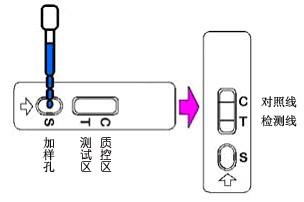
Remove the test strip from the aluminum foil bag, place it flat with the front side up as shown in the figure below, and use a pipette to add 3–4 drops of the prepared sample extract solution to the sample well.
4. Result Interpretation:
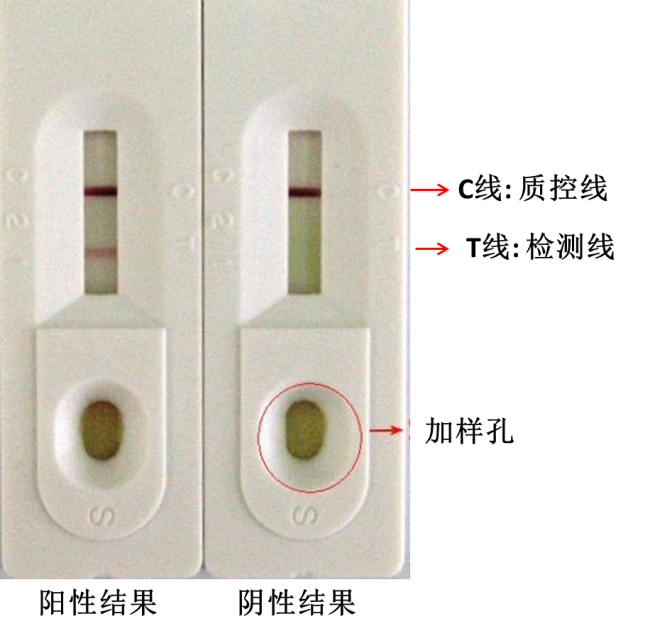
Observe the results within 3 to 10 minutes. As shown in Figure 1 below, positive results are indicated by color development at both the C line (control line) and T line (test line). As shown in Figure 2 below, negative results are indicated by color development only at the C line and no color development at the T line. If neither the C line nor the T line shows color development, or if color development occurs only at the T line and not at the C line, the test strip is invalid.
III. Precautions:
1. When testing plants, the amount of diseased leaves collected should not be excessive; strictly control the sampling volume—half or the size of a thumb nail is sufficient. Collecting too many leaves will cause the chlorophyll in the leaves to interfere with the color development during detection. Moreover, this test strip exhibits extremely high sensitivity, eliminating the possibility of false-negative results due to insufficient sample volume.
2. The test strips are stored in a dry, sealed aluminum foil bag and should be used immediately upon preparation.
3. The test strip is used for the detection of PMMoV.
4. During sampling, tomato leaves exhibiting pronounced viral symptoms should be collected. Symptoms of PMMoV infection in chili plants include: leaf chlorosis and wrinkling, appearance of brown necrotic spots on stems, fruit distortion, wrinkling, deformation, and reduction in size; occasionally, brown necrotic lesions, discoloration streaks, and ring patterns may appear on fruits, accompanied by stunted plant growth.
5. Collect samples using hands, scissors, or blades; after each sampling, thoroughly rinse the instruments with tap water.
6. The colloidal gold test strip must be processed using the provided sample extraction solution; other sample extraction solutions are not permitted.
7. Each pipette tube may only be used for the aspiration and addition of one sample; it is prohibited to use the same pipette tube for multiple samples.
IV. Storage Conditions: Store at room temperature (4°C–35°C) protected from light; do not refrigerate or freeze.
V. Production Date and Shelf Life: The production date is indicated on the packaging box, with a shelf life of 24 months.
Copyright © 2024-2025 Hangzhou JEL Technology Co., Ltd.
All Rights Reserved. 浙ICP备2024090592号