

The Tomato Brown Rugose Fruit Virus (ToBRFV), belonging to the family Astroviridae and the genus Tobacco Mosaic Virus, is a pathogen recently identified that affects crops such as tomatoes and peppers. Due to the severity of its damage and its high risk of seed transmission, multiple countries, regions, and organizations have issued warning notices or implemented corresponding phytosanitary measures.
Main Distribution
To date, ToBRFV has been reported in multiple countries and regions, including Germany, the United Kingdom, Italy, Greece, the Netherlands, Spain, France, Mexico, the United States, Israel, Jordan, and Turkey. Among these, the virus is most widely distributed in Israel, covering all tomato cultivation areas in the country.
Host and Symptoms
ToBRFV primarily infects plants such as tomatoes and peppers, with artificial host species including amaranth, kumno amaranth, tobacco, petunia, and solanum.
When ToBRFV infects tomatoes and peppers, the disease primarily affects the leaves and fruits. In tomatoes, the leaves exhibit chlorosis, mosaic patterns, and mottling, sometimes accompanied by leaf narrowing, deformation, and necrosis; the fruits display green, yellow, or brown spots, rough surfaces, and deformities, with necrosis observed on petioles, pedicels, and calyxes. The symptoms in peppers are similar to those in tomatoes, mainly manifesting as leaf deformation, yellowing with spots, and fruit deformation with yellow, brown, or green stripes.
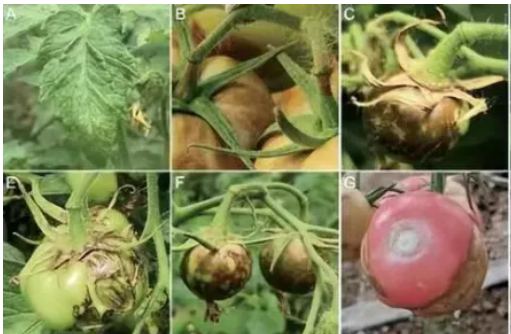
Tomato Brown Fruit Virus
ToBRFV Test Strip Instruction Manual
I. Kit Composition:
ToBRFV test strips, 50 strips
Plant tissue grinding bags, 50 pieces
50 mL sample extraction solution per bottle
II. Operating Steps:
1. Sample preparation:
1.1 Method 1 for Plant Sample Preparation:
1) Collection of plant samples: Take a half-thumb-nail-sized leaf fragment (30–50 mg) from tomato leaves exhibiting pronounced virus-like symptoms such as mosaic, using hands or scissors, and place it into the provided plastic grinding bag.
2) Grinding and homogenizing plant samples: Use the provided pipette to transfer 2 tubes of sample extract (approximately 1 mL) into the grinding bag containing the leaves. Rub the plastic bag with both hands as if washing clothes until the leaves are completely crushed, then mix thoroughly with the sample extract.
1.2 Method 2 for Plant Sample Preparation:
1) Collect tomato leaves exhibiting prominent viral-like symptoms such as mosaic lesions, weigh them, and then take approximately 30–50 mg of leaf tissue and place it in a mortar;
2) Add 1 mL of the extract solution to the mortar and grind with a grinding rod to obtain a homogenate for 1 minute;
3) Transfer the homogenate to a 1.5 mL plastic centrifuge tube and centrifuge at 5000 rpm for 3 minutes, or let it stand for 3 minutes; the supernatant serves as the sample testing solution.
2. Sample Testing:
Remove the test strip from the aluminum foil bag, place it flat with the front side up as shown in the figure below, and use a pipette to add 3–4 drops of the prepared sample extract solution to the sample well.

4. Result Interpretation:
Observe the results within 3 to 10 minutes. As shown in Figure 1 below, positive results are indicated by color development at both the C line (control line) and T line (test line). As shown in Figure 2 below, negative results are indicated by color development only at the C line and no color development at the T line. If neither the C line nor the T line shows color development, or if color development occurs only at the T line and not at the C line, the test strip is invalid.

III. Precautions:
1. When testing plants, the amount of diseased leaves collected should not be excessive; strictly control the sampling volume—half or the size of a thumb nail is sufficient. Collecting too many leaves will cause the chlorophyll in the leaves to interfere with the color development during detection. Moreover, this test strip exhibits extremely high sensitivity, eliminating the possibility of false-negative results due to insufficient sample volume.
2. The test strips are stored in a dry, sealed aluminum foil bag and should be used immediately upon preparation.
3. The test strip is used for detecting ToBRFV.
4. During sampling, tomato leaves exhibiting pronounced viral symptoms should be collected. Symptoms of ToBRFV infection in cucurbitaceous plants include chlorosis, mosaic lesions, leaf narrowing, petiole necrosis, brown wrinkled fruits, and fruit drop.
5. Collect samples using hands, scissors, or blades; after each sampling, thoroughly rinse the instruments with tap water.
6. The colloidal gold test strip must be processed using the provided sample extraction solution; other sample extraction solutions are not permitted.
7. Each pipette tube may only be used for the aspiration and addition of one sample; it is prohibited to use the same pipette tube for multiple samples.
IV. Storage Conditions: Store at room temperature (4°C–35°C) protected from light; do not refrigerate or freeze.
V. Production Date and Shelf Life: The production date is indicated on the packaging box, with a shelf life of 24 months.
Copyright © 2024-2025 Hangzhou JEL Technology Co., Ltd.
All Rights Reserved. 浙ICP备2024090592号


